Wednesday, January 23, 2008

How Working-out and Fasting Effects Your Blood Sugar

Here is another great post about fasting, workouts and your blood sugar.


BP

PS- Please remember, all of these experiments and recommendations are for healthy individuals, if you are diabetic your physiology is different.

PPS- I'm toying with the idea of making Eat Stop Eat Advanced into a DVD as opposed to making it a really big book. Let me know which you would like better...

Stumble Upon Toolbar

Friday, January 18, 2008

More info on Working out while Fasting

John Barban did a similar experiment to mine, measuring his blood sugar while completing a workout.


You can read about his finding by visiting here==> 


BP


You can learn more about the combined effects of exercise and fasting for weight loss by visiting www.eatstopeat.com

Stumble Upon Toolbar

Thursday, January 17, 2008

Fasting and Exercise

I've had a number of people ask me about the effects that fasting and exercise have on blood sugar.


In clinical research there generally isn't a concern that exercising while fasting will cause an ill effects to a persons blood sugar. The body is remarkably good at regulating blood sugar levels, even in the face of intense exercise.


In fact, most of the research on weight training and protein synthesis is conducted on people who have been fasted for anywhere between 12 and 16 hours. And, we know that there are professional athletes who play full NFL games in the fasted state.


However, as I have stated before, there is a difference between research and the real world. Most importantly, in research the people who participate as the subjects are always screened to make sure they are healthy, and that they do not have any underlying medical conditions that may effect the results of the study.


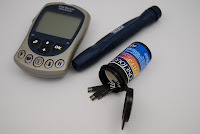
So, I figured this would be another great time to experiment on myself, using my dreaded glucometer.


After I was fasted for 22 hours, went to my Krav Maga class and took part in an hour of practicing leg kicks, body kicks and kicking and striking combinations. It was a hard class and I definitely sacrificed the health of my shins in the name of research!


Here are the results.


I started the class with a blood sugar of 4.7 mmol/L, pretty typical for me during fasting.


After an intense 15 minute warm-up of sprints, sprawls and various body weight exercises I retested by blood sugar and had a reading of 3.9 mmol/L (This is the lower end of normal, however I felt fine).


After the warm up we went right into shins kicks and defences with lots of moving around and striking, I was definitely sweating, and working hard, I took a quick break and tested my blood sugar which was at 5.6 mmol/L (This score is about the same as I would see after a meal)


We followed up with more pad work, throwing in some body kicks and more combinations and making sure our footwork was good, right at the end of the class I measured my blood sugar again and it was at 5.3 mmol/L (looks like I'm already returning to normal)


15 minutes after class my blood sugar was back down to 4.2 mmol/L. thirty minutes later it was 4.7 mmol/L and then right before my fast ended at 2 pm my blood sugar was 4.4 mmol/L. (Right back to where I should be. Time to eat.)


Just another example of the bodies ability to regulate blood sugar, even while fasted and exercising intensely.

BP

Stumble Upon Toolbar

Monday, January 14, 2008

Brad's Predictions for 2008


Alright, I know I'm a little late on this one, but here it goes...these are my predictions for the health and fitness industry in 2008.

1)Eat Stop Eat will be the next Atkins Diet

This prediction may sound a little conceited, but the idea of using short periods of fasting for weight loss is definitely catching on. And it shares a number of similarities with the Atkins Diet - it is incredibly effective and it is controversial because it flies in the face of some of our current nutrition fads, just as the Atkins Diet did. The only difference is, Eat Stop Eat is flexible and easy, so for this reason it may become quite as popular as Atkins (for some reason, people love complexity).

(The next big thing?)

2)People you trust are going to start pushing supplements on you

eTrainers and other on-line fitness experts who used to "rage against the supplement industry" will soon start pushing you on supplements as they begin to realize what the supplement industry has known for a longtime - the reoccurring income these products can generate is a quick and easy way to make a lot of money.

(These guys are Different...this stuff is great)

3) We will start to realize that our obsessive compulsive relationship with food is slowly ruining our lives.

Eat six times a day. Only eat protein with fat. Eat low glycemic. Eat to "fuel the machine". I think this year people will finally start to realize that the obsession with trying to figure out what and how to eat to lose weight has left us as a group of neurotic eaters who are more confused and frightened of food than we ever were before.


(I don't care how much it weighs, I'm eating the whole apple!)

4) Everyone will be taking pictures of their food and blogging it.

I think it may have been either Art Devany or Dr. Eades who started this trend, and they both did it with good intentions. It started off as a way of showing people that eating lower carb foods can still involve very appealing looking foods. In 2008 this idea will be bastardized and turned into a competition of "look how healthy I eat" between health and fitness bloggers.

(I'd post a pic of what I ate today, but I was fasting)
BP

Stumble Upon Toolbar

Wednesday, January 09, 2008

Fasting for Weight Loss and its Effect on Blood Sugar


In the last couple days I've received a number of emails and posts about using short periods of fasting for weight loss and its effect on blood sugar.

In a post to my blog I was told that a couple people who are diabetic have been using short periods of fasting with a lot of success and have actually been able to lower the dosages of their medications.

I also received an email from a personal trainer who wants to use Eat Stop Eat with her clients but is worried about the effects that using short periods of fasting for weight loss would have on blood sugar levels. Mostly, she was concerned about hypoglycemia.

Throughout the 24 hour cycles of eating, digestion, and fasting, the amount of glucose in your blood is generally maintained within a range of 70-140 mg/dL (3.9-7.8 mmol/L) as long as you are healthy.

Hypoglycemia is another way of saying "low blood sugar". While many people claim to suffer from low blood sugar, as little as 5-10% of the population actually have a malfunction in their ability to regulate their blood sugar levels. There is no actual "cut off" value for blood glucose levels that truly defines hypoglycemia for all people and purposes.

Research in healthy adults shows that mental efficiency declines slightly but measurably as blood glucose falls below about 65 mg/dL (3.6 mmol/L). However, the precise level of glucose considered low enough to define hypoglycemia is dependent on the age of the person, the health of the person, the measurement method, and the presence or absence of negative effects.

According to the research on using fasting for weight loss, a 24 hour fast should not place you into a hypoglycemic state, and I have not seen any research that has shown a subject going below 3.6 mmol/L blood sugar during a short term fast. However, I'm the first to admit that there is a difference between research and real life, so I decided to experiment on myself.

I took blood glucose measurements on myself during a 24 hour fast. It's important to note that this investigation only had one subject (me) and that testing hypoglycemia with the finger prick technology is prone to misleadingly low numbers. Nonetheless, I couldn't help but be intrigued with what I may find.


(Good for research, bad for my fingers)

I started my experiment at 1:10 pm with a Bowl of Chili, a whole wheat bun an old fashion dip donut and a large coffee with two cream and one sugar, all courtesy of my friends at Tim Hortons ( ~750 Kcals, 40 g fat, 70 g Carbs, 30 g Protein)


I began measuring at 2:15, exactly 45 minutes after my last sip of coffee. The first numbers are my blood glucose in mmol/L, the number in brackets is my blood glucose levels in mg/Dl.


2:15 PM TUES- 5.9 (106.2)

4:15 PM TUES- 4.8 (86.4)

6:15 PM TUES- 4.4 (79.2)

8:15 PM TUES- 4.3 (77.4)

10:15 PM TUES- 4.6 (82.8)

12:15 AM WED- 4.0 (72) (Bed Time)

3:15 AM WED- 4.4 (79.2)

6:15 AM WED- 4.7 (84.6) (Right after I woke up)

8:15 AM WED- 4.6 (82.8)

9:00 AM WED- 4.4 (79.2) (A little bit of hunger here)

10:15 AM WED- 4.1 (73.8)

12:15 PM WED- 3.9 (70.2)

1:30 PM WED- 3.9 (70.2)


At 1:30 I ate my first post-fast meal, which was supposed to be a small chicken salad, but unfortunately it was a 1,200 Kcal Bomb of a salad from Boston Pizza (1,200 Kcals, 86 g Fat, 45 g Carbs, 62 g Protein)...My mistake, I was at a business meeting, but still, I should have known better.


Twenty minutes after finishing my heart attack of a salad, I started recording again.


2:00 PM WED- 5.9 (106.2) 20 minutes after my last bite

2:20 PM WED- 5.8 (104.4) 4o minutes after my last bite

2:45 PM WED- 4.8 (86.4) 65 minutes after my last bite

4:45 PM WED- 4.4 (79.2)


The interesting things I learnt from this study were that my feelings of hunger were not related to my blood sugar levels, nor was any feeling of light-headedness.


I was also very surprised that despite the massive amounts of sugar, my blood sugar never went above 6, and dropped pretty quickly after my meals. It stayed pretty tightly controlled between 3.9 and 5.9.


All in all, this experiment showed me that while I am fasting my blood sugar stays within the normal range. I will repeat the experiment during my next fast and study what happens when I workout while fasted.


BP

Stumble Upon Toolbar

Tuesday, January 08, 2008

How I eat on non-fasting days

I received an email today that said:


"I noticed someone commented on one of your blogs asking about what your diet is like on your non-fasting days, but you didn't answer so it actually made me curious as to what your non-fasting day diet really is like."


Oops. I Apologize for missing that one.


I've never really stopped to think about how I would describe how I eat, but I'll give it a try...


On my non-fasting days I eat for taste and I try to eat responsibly.


I tend to avoid fast food and I make a conscious effort to eat fruits and veggies when possible. I drink way to much coffee and I think I may be addicted to chocolate milk. I don't eat "low carb" or "high protein" or follow any other plan. I think I probably eat a little more protein than the average person and probably less sugar, but really I don't think about it too much.

(It just tastes good)

In all honesty, I think the obsessive compulsive approach to nutrition that is so prominent these days does more harm than good. Think about it, when fitness models and bodybuilders bring electronic scales to resturaunts to weigh the tuna on their salads, we commend them for being dedicated?!? To me this represents everything that is wrong with nutrition today.

It doesn't have to be this complicated.


BP


learn more about fasting for weight loss

Stumble Upon Toolbar

Monday, January 07, 2008

The 3 Keys of Exercise and How to Lose 200 Pounds

Once a year, NCAA football comes to Canada, and this year, I was there.


My wife and I met some friends in Toronto Ontario to watch Rutgers take on Ball State in the International Bowl. We had a great time watching Ray Rice run for 280 yards and 4 touchdowns.


While not everyone thinks attending a football game is an amazing event, I think everyone will agree that losing 200pounds with Eat Stop Eat definitely classifies as amazing.

3 of the people we were sitting with had been following EatStop Eat since the summer, and these three guys had combined for over 200 pounds worth of weight loss. I barely recognized two of them the change was so dramatic!

When it comes to diets I think that Eat Stop Eat could very well be the easiest path to weight loss. Not the only path, but the easiest and the most flexible.

You can think of diets the same as we do exercise; to make it work you have to adapt it so that it fits into your life. If youdon't then you are setting yourself up for failure.

With exercise there are three 'master components' to your workouts and the adaptations they cause your body to undergo.

These components are - Frequency, Volume, and Stress

You need to hit a minimum amount of all three to get an effect, and this minimum continually increases as your bodyadapts to the workouts. In other words, the bigger and stronger your muscles get, the harder and harder you have towork to make them continue to get stronger.
Thus, the absolute best scenario would be for all three components to be at their maximum. Maximum stress,maximum volume and maximum frequency (and maximum recovery in between workouts).

Multiple training sessions per day (frequency) at a maximalweight (stress), with as much sets and reps as possible while maintaining above the minimum stress level (volume).

You have real responsibilities in life, so this just isn't possible. So you do that best you can with these 3 factors ina method that fits your lifestyle. Whether it's 3 times perweek, 4 times per week, 2 times per day twice a week, you should do what fits into your life style.

The same principle applies to your diet. Ideally you would control every single days worth of nutrition. In fact, ideally you would control every single hour. You would measure exactly how much food you take in (volume) how often youeat (frequency) and what you are eating (stress). But again,this just isn't possible for 99.9% of the population. (elite athletes are an exception)

This is why Eat Stop Eat works so well for weight loss. It is aflexible adaptation to the rules of dieting that actually worksin real life scenarios.

Your mission (should you choose to accept it) is to find a wayto fit exercise and nutrition into your lifestyle.

BP


PS- For a really good critique of Eat Stop Eat you can readRichard Nikoley's review by going HERE

Stumble Upon Toolbar

Friday, December 21, 2007

How to gain 10 pounds of muscle and lose 5 pounds of fat in only 2 days

On Tuesday I did an interview with Craig Ballantyne about my experiences with body transformations. It was a really fun interview, we covered a lot of topics, including how to use the Eat Stop Eat style of eating for a body transformation and my experiences with doing a bodybuilding contest a couple of years ago. While these topics were cool, the most interesting point we covered was when we started talking about the difference that a tan, moisturizer, shaving and a workout pump could have on the way you look.


If you are entering Craig's Turbulence Training transformation contest this will be an ace up your sleeve.


By getting a tan, making sure your skin is well moisturized, shaving your body hair (guys) and getting a pump at the gym, you can easily make yourself look 10 pounds more muscular and 5 pounds less fat. This is very important when you are doing your Before and After photos.


To illustrate my point, I took these two pictures two days apart:


The picture on the left is just regular old me. I'm not fasted, and I'm not flexing. I'm 177 pounds and my normal body fat levels (Thanks to following the Eat Stop Eat lifestyle). I'm not sticking my gut out, or trying to look miserable (although I took the pic at midnight so I do look a little tired).

The picture on the right is regular old me after a couple tanning sessions, a quick shave of the chest and one really good chest and shoulders workout. I'm still 177 pounds and the same amount of body fat that I was two days before in my before picture.

To keep this experiment honest I did not fast in-between shoots and the only workout I did was the one right before the photo on the right.

As I hope you can see, some well timed pre-photo prep work can do wonders for your before and after pics. And, it is very important that you take this into consideration when you are doing your before and after photos for Craig's contest. Also, you should keep this in mind the next time you are looking at a weight loss supplement ad that uses Before and After pictures as testimonials to how effective the product is (If I could do this in two days, imagine what could be done in 8 weeks).

Bottom line- Make sure you don't try to "fake" your before pics, keep them honest, and when it comes to your after pics make sure you take the proper steps to really show off your hard work.

BP

PS- Both these pics were taken in my house with regular lighting, if I really wanted to make the difference extreme I would have used better lighting in the after photo.

PPS- If you want to learn more about how I eat and the methods I use to stay in shape then check out www.eatstopeat.com to learn more about fasting for weight loss

Stumble Upon Toolbar

Thursday, December 20, 2007

Montreal, Snow Storms and the role of carbs in weight loss

It's been a crazy week for me. I was in Montreal for the weekend, checking out the local cuisine. I had some very tasty duck, and some amazing raw fish at Buona Notte (I highly recommend this restaurant!) Unfortunately, on Sunday I was caught in that huge snow storm that pummeled southern Ontario. Needless to say, what should have been a 6 hour drive home ended up taking almost 11 hours!

By the time I finally got home I was so behind on work that I had to spend the last couple days trying to get caught up on emails. One of the emails I received had a really great question asking whether it's carbs or calories that causes weight gain. I've copied the question and my answer below...

Hi Brad,

I've read your book Eat Stop Eat and I'm wondering whether you would have written it differently now that you've read "Good Calories, Bad Calories" by Gary Taubes. I mean, in your book you still write as if the amount of calories matter and as if you shouldn't differentiate between them. What Taubes has found is that the only thing you really can say is that too many Carbs are unhealthy.

George

And here is my answer:

Hi George,

Thanks for the email and for the excellent question.

I have read "Good Calories, Bad Calories" and was very impressed with its content. I believe that Taubes has accurately pointed out the health issues surrounding a high sugar intake. However, I do not believe that he accurately analyzed the data regarding the correlation between total calories and obesity.

Taubes examined studies containing diet record data and concluded from this research that the obese do not eat any more calories than non-obese people. Unfortunately, we have learned from the work of Brian Wansink that obese people tend to under report their caloric intake by as much as 30% when using diet records. This phenomena has been noticed by other researchers, and has been written up as an extremely important confounder in weight loss research. (For a great write up on this point you can see a Trial by Steven W. Lightman et al. published in the New England Journal of Medicine, volume 327 (37), 1992.)

For this reason I would not have changed any of my recommendations in Eat Stop Eat if I had read "Good Calories, Bad Calories" before I began writing.

I think that the points that Taubes makes about sugar are accurate, and I do believe that one or two 24 hour periods of complety no sugar (like during the Eat Stop Eat method of fasting) is beneficial to human health, yet I also believe that the only way to reduce body weight is through a negative caloric balance, and the best way to ensure that the majority of that weight loss is fat is by using the combination of caloric restriction and resistance exercise (the two keys to Eat Stop Eat's success).

I hope this answer helps,

Brad

To learn more about the benefits of short periods of flexible fasting for weight loss, visit http://www.eatstopeat.com

Stumble Upon Toolbar

Monday, December 17, 2007

Linza's First Day on Eat Stop Eat

If you are interested in reading about some one's experiences with her very first day on Eat Stop Eat, then check out Linza's blog at http://willworkforabs.com/2007/12/17/my-first-eat-stop-eat-day/ !

A great post and a really good account of what your first day on Eat Stop Eat might feel like.

BP


Learn more about using flexible fasting for weight loss

Stumble Upon Toolbar

Wednesday, December 12, 2007

Fasting Benefits Your Heart

My mom sent me a text yesterday about a study out of the University of Utah. Apparently, according to this study, people who fast one day a month are 40 percent less likely to be diagnosed with clogged arteries than those who did not regularly fast.

Sounds like great news, especially if you are like me and fast 6 to 8 times per month.
Unfortunately, after looking over the study, I did a google search to see what the newswires were reporting and found some very disheartening news bytes.

According to an article I found on Yahoo News, when asked to comment on the study Dr. Raymond Gibbons of the MayoClinic (who was not involved in the study), stated "Fasting resets the metabolic rate".

Now I'm not sure what Dr. Gibbons meant by "resets", and he was probably speaking about long term chronic fasting,but the author of the article on Yahoo News added these words after Dr. Gibbons quote "slowing it down to adjust to less food and forcing the body to store calories as soon as people resume eating".

These words cannot be Dr. Gibbons. They just can't be. There is no way I can accept that a former heart association president would make such an incorrect statement, especially since it was in reference to a 24 hour fast.

This begs the question, why is the mainstream media so afraid to tell people to eat less? Why is it that when research on the benefit of brief periods of fasting comes out, people have to comment on the dangers of long term chronic fasting.

Instead of just explaining that as little as one 24 hour fast per month can reduce your chances of being diagnosed with clogged arteries, they have to start digging to find something,(completely unrelated to the study), so they can throw some negative comments into the fray.

If you've read Eat Stop Eat, you know that metabolism doesnot decrease during brief fasting. In fact, evidence suggests that it may even go UP!

I know it will be an up hill battle, but my goal is to make the use of brief periods of fasting a respected and established method of weight control...because it is easy and because it works.

Are you fasting today?

BP

EAT STOP EAT, its easy, its effective, and new research suggests it's good for your ticker!

Stumble Upon Toolbar

Saturday, December 08, 2007

Are you fasting today?

You'll never guess what happened to me this week.

I was at a lunch meeting, just finishing my coffee when someone came up to my table to tell me that she had just started Eat Stop Eat.

To be honest, it was a little weird to be approached in public, but it was an awesome feeling to be able to actually see her excitement. And, it was an even better feeling knowing that she was going to see results!

My goal is to make the question "Are you fasting today?" as common as "Did you want to go eat?". If this happens, it means people are finally losing weight without the pain of constantly dieting. Without having to cut carbs for months on end, and without the pain of taking a week off of dieting only to watch the pounds practically jump back onto their bodies.

So with New Year's fast approaching, it's time for you to help spread the word. If you have been practising Eat Stop Eat, and have seen great results, it's time to let your friends in on your little secret (it's the holiday season, so don't be greedy and keep it all to yourself!)

This holiday season you can do your part to stop the needless diet suffering that always happens this time of year.

Eat Stop Eat, help spread the word

BP

PS- Haven't read Eat Stop Eat yet? You can check it out byclicking here ==> www.eatstopeat.com


Fasting for weight loss

Stumble Upon Toolbar

Friday, November 30, 2007

Should you be on GH?

I’m willing to admit I abuse GH. In fact not only do I abuse GH, but many top, well-known fitness gurus abuse GH too!

Now I know what you are thinking…Brad couldn’t possibly be talking about growth hormone..the same hormone that Hollywood celeb’s (guys and girls) are rumoured to pay thousands of dollars for in an attempt to lose fat and stay young looking? The same GH that all the home run slugglin’ baseball players are getting caught using?

Yep, it’s that GH!

Now, before you get ready to turn me into the authorities, let me explain…

Anybody who has read Eat Stop Eat knows my opinion on the connection between fasting and growth hormone. And since I follow the Eat Stop Eat lifestyle, my GH levels are normally pretty high.

The interesting thing about GH is that many other fitness pros are abusing GH and they don’t even know it!

There is an important and often underestimated relationship between exercise and GH release. As little as ten minutes of intense exercise can have profound effects on increasing GH levels!

Hmmm, ten minutes of super intense exercise…sound familiar? Anyone who has ever done ten minutes of interval training knows just how intense this can be.

That’s right, turns out intervals and fasting share some similar benefits…they are both great fat loss tools and they both cause rapid increases in GH release.

So, why should you care?

Well, GH is being studied for a lot of cool things, like its ability to increase fat burning, to increase muscle mass and for its ability to make your skin look younger by improving its hydration. While this research is still ongoing, it is starting to show an interesting relationship between GH levels, body composition and aging.

So my advice is simple. Whether you are following the Eat Stop Eat lifestyle or not, try doing ten minutes of intense exercise every single day. I’d suggest getting it done right before your morning shower (It could be a bodyweight circuit of Y-squats, push-ups, lunges, stick-ups). This way, your GH will be elevated at some point during every day of the week.

Every little bit helps,

BP


Fasting and growth hormone

Stumble Upon Toolbar

Thursday, November 22, 2007

DHA - The secret to Fish Oils

After a nice little break attending conferences in Florida, I'm right back into attending seminars in Canada.

Normally, I probably would have taken a day or two off, but yesterday's seminar was on a topic I've always found somewhat confusing - fish oils.

After sitting through a very entertaining lecture, I can tell you that the most important thing you need to know about fish oils is actually the three letters. D-H-A.

These three letters stand for the omega 3 fatty acid Docosahexanoic Acid, but since that's a bit of a tongue twister, everyone just says "DHA".

For all purposes DHA is the reason omega-3 supplements are so popular right now.

DHA is the component of fish oil that plays an important role in the development of brains and eyes of children, and may play a role our brain development even as adults.

The 'Secret' of fish oil is that the daily intake of DHA in North America is incredibly low. North American women tend to average around 80 mg per day of DHA, while children under the of 3 have a daily intake of less than 20 mg. So even the smallest amount of extra DHA in your diet could double your intake!

Now, increasing your intake of omega-3 oils from plants like flax seeds or flax seed oil will do very little to help boost your DHA levels. As it turns out, the best way to increase your DHA levels is by eating DHA. And that means eating more fish, fish oils, or some of the new algae based products that have also appeared on the market.

Now, before you start saying "but Brad, I hate fish and I hate the fish burps I get from fish oil capsules", let me tell you the good news- There are other options.

The next time you go to the grocery store, keep an eye out for foods that now have extra DHA in them. There are eggs and milk that have the added DHA, and of course my favorite, the chocolate milk with DHA. A food that adds as little as 10 mg of DHA to your diet per serving could drastically improve your DHA intake.

Here's my tip for you today - If you don't like fish and don't like taking pills, you can increase your DHA with these new functional foods (and they still taste great). A little extra could go a long way in helping you reach optimal health.

Brad and the team at grrlAthlete.com


PS- If you want to learn more about the health benefits of DHA you can visit the website DHAomega3.org

Stumble Upon Toolbar

Tuesday, November 20, 2007

6 Pack Abs, Made Easy

I just got back from a long weekend of travel. I spent the past 4 days in Florida, talking with a very interesting group of fitness professionals about the benefits of Eat Stop Eat.

I literally spent the entire weekend "talking shop". I never even had the opportunity to step outside into the warm Florida sun, not even for five minutes! And trust me, since I live in Canada, I was really looking forward to the feeling of the warm Florida sun rays beating down on my face!

However, the weekend was amazing (even though I'm completely lacking any form of a tan).

Several times during the conference I was asked, "Brad, I've heard about your book, and I wanted to ask you, in your opinion what is the number one benefit of Eat Stop Eat?"
Depending on who I was talking to (the audience ranged from personal trainers to PhD's) my answer varied from talking about the improvements in insulin sensitivity, to the flexibility of the program and how easy it is to follow.

It wasn't until I was back in my hotel room, getting ready for bed after a long day of lectures and seminars that I realized, for me, the number one benefit of Eat Stop Eat is the way it makes me look.

I know this sounds conceited and maybe even a little vain, but its true. I like my abs.

I have been practicing the Eat Stop Eat method of flexible fasting combined with resistance training for over a year now, and for over a year, I have never been more than 5 pounds off of my goal weight.

There is a certain freedom to knowing that you have found a program that works well, fits easily into your lifestyle and is completely uncomplicated.

And, come to think of it, this is the main reason that I wrote Eat Stop Eat - because I wanted to share this feeling with you.

So, if you haven't had the chance to check out Eat Stop Eat, please take a look at the following website ==> http://www.eatstopeat.com/.

It could very well be the program that you've been looking for.The one that can give you the freedom to feel great about the way you look, without complicating the way you eat.

BP

PS- Just so you know I practice what I preach, I made sure to do a flexibel 24 hour fast on my travel days, so I could avoid the tempting call of my airport Nemesis - The smell of Cinnabon.

Stumble Upon Toolbar

Thursday, November 15, 2007

Cereal, Kids and Diabetes

I woke up early this morning to find the following email in my in box from the American Diabetes Association.

"The number of children and adolescents with type 2 diabetes is on the rise as more and more kids become obese. The National Institutes of Health and the U.S. Centers for Disease Control and Prevention co-sponsored the latest efforts of the National Diabetes Education Program (NDEP) to provide parents and teens with the tools necessary to reduce their risks of complications related to type 2 diabetes and manage their disease."

Considering the post I just wrote about snack foods and breakfast cereals, I thought this was very timely.

BP

Stumble Upon Toolbar

Wednesday, November 14, 2007

Snacking, Obesity, and Making Healthy Food Choices

Today I was in a mood for some snacks. So when I finally made it home and saw that my wife had bought my favorite breakfast cereal I knew it just had to be.

After I finished pouring myself a bowl, I noticed that the nutrition information was indicated for one cup of cereal. One Cup? This is what one cup of cereal looks like...


This made me curious, how much cereal do I usually 'free pour' for myself? After measuring my cereal I was shocked to find that I usually pour 3 cups of cereal for myself. Now, my bowl was not overflowing with cereal...In fact I think it looked pretty normal. Here's a picture...

To make sure I was not just being a little over zealous with my pouring, I had my wife pour herself a bowl, with instructions to pour an "average amount". This is what she poured...


She poured a little over two cups of cereal. Since the recommended amount of cereal is one cup, and I poured myself 3 cups, and my wife poured a little over 2 cups, I decided to take the middle ground and look at the nutritional profile for two cups of cereal. It looks like this...
Calories 460
Fat 9 g (saturated 3 g)
Cholesterol 0 mg
Sodium 210 mg
Potassium 820 mg
Carbohydrates 86 g
Fibre 8 g
Sugars 26 g
Protein 10 g
WOW. So what I was about to eat as my "Snack" was going to be almost 1,000 Calories (3 cups of cereal with a cup of skim milk).
But let's stick with the 2 cups of cereal and compare it to my other favorite snack...


The nutrition profile for a Dairy Milk looks like this..


Calories 220
Fat 12 g (saturated 7 g)
Cholesterol 10 mg
Sodium 70 mg
Potassium NA
Carbohydrates 26 g
Fibre 1 g
Sugars 22 g
Protein 4 g


So, the question is, which one is the better snack?


I compared the middle ground of the cereal intake (2 cups) to one bar of Dairy Milk (Even on a really bad day, I couldn't eat two chocolate bars in a row and not feel gross)

The cereal has added vitamins and minerals, has 6 grams more protein, 7 grams more fibre and 4 grams less saturated fat than the chocolate bar.
However, the candy bar has 24o less calories, 60 grams less carbohydrates and 4 grams less sugar than the cereal.
Comparing the ratios of protein to carbs, the cereal has a 1:8.5 ratio of proteins to carbs (I rounded down) while the candy bar has a protein to carbs ratio of 1:6.5.


So the question becomes is 6 grams of protein, 7 grams of fibre and 4 grams less saturated fat more important than the extra 240 calories, 60 grams of carbohydrates and 4 grams of sugar?


To tell you the truth, I'm not sure which is the better snack. I'm leaning towards saying the Diary Milk would be the healthier option, because I have a hard time beleiving the health benefits of an extra 6 grams of protein and 7 grams of fibre are worth the extra 60 grams of carbohydrates, however I know I can eat 3 cups of cereal and feel alright, but if I ate 3 Dairy Milks in a row, I'd be hurting. (which could be viewed as benefit as I simply cannot overeat chocolate to the degree I could with cereals)

My final point is that I think this little experiment illustrates the fact that when we are pointing fingers and proclaiming that certain food groups are causing our obesity crisis and our failing health, we may want to be careful who we are pointing at and why we are pointing at them.


BP


PS- I'd love to hear your opinion...which do you think is the healtheir snack?


PPS- With Thanksgiving fast approaching, and the Winter Holidays after that, maybe it's time you took a look at my weight loss program Eat Stop Eat, and avoid the winter 10.

Stumble Upon Toolbar

Sunday, November 11, 2007

Food, Not Specific Nutrients, May Be Key to Good Health

Here is a review of a very interesting bit of research that was published in last month's Journal of Nutrition Reviews.

Food, Not Specific Nutrients, May Be Key to Good Health

In a way, this exemplify's both Eat Stop Eat and Nutrition by Addition, as it points to focusing on food, rather than specific nutrients in your approach to overall health.

Happy Reading,

BP

PS - I received an absolutely amazing email from someone who has lost an impressive amount of weight while making some quality changes in his life, including incorporating the Eat Stop Eat of fasting for weight loss. You can read his email as the bottom of this page => HERE

Stumble Upon Toolbar

Thursday, November 08, 2007

How much protein do you need to build muscle?

The idea that you need massive amounts of protein in your diet in order to build muscle is one that will probably never go away. While I agree that many of us need to eat a little more protein than we typically do, I don't think we need super-mega amounts in order to pack on muscle.

In a really interesting study published back in 1996, 43 men who were experienced weight lifters took part in a study that involved exercise and weekly injections of testosterone enanthate for 10 weeks.

Yep, these boys were on steroids for the benefit of science!

They were divided into 4 groups.

  • The first group performed no exercise and didn't get any steroids.
  • The second group performed exercise but didn't get steroids,
  • The third group didn't exercise but received the weekly injections and
  • The fourth group exercised and received the injections.

As you can imagine after 10 weeks of lifting weights 3 times per week, the group that was receiving the steroid injections gained over 13 pounds of muscle.

The group who were just working out didn't do too bad either, packing on almost 4.5 pounds of muscle in only ten weeks.

The guys who sat around doing nothing for 10 weeks but received the steroid injections still had an increase in lean mass (almost 6 pounds), while the group who received no steroids and didn't workout did not see any change in their lean mass.

So what does a study on steroids have to do with nutrition? well, all four groups were on the same diet. They were all consuming about 0.7 grams of protein per pound of body weight and about 16 Calories per pound of body weight.

What this shows is that for a group taking steroids while exercising, 120 grams of protein per day was enough to supply the amount of protein needed to allow for a 13.5 pound gain in lean mass!

It was also the same amount of protein the the exercise only group ate to gain 4.5 pounds, and the other groups ate to see their gains, (or lack thereof).

What this shows is that for the groups who saw less gains in lean mass then the steroid group, the amount of protein that they ate was not what determined how much muscle they gained. The workouts and the steroids did that.

In the end, protein is important, but as this study shows, 0.7 grams of protein per pound of body weight is enough daily protein to allow for a 13.5 pound increase in lean mass in 10 weeks. It's also enough to allow for a 4.5 pound increase in people not taking steroids, which is still very impressive muscle growth for a ten week period!

BP

For those of us who are not 'pharmaceutically enhanced' this study helps support the idea that your workout is the most important part of your muscle building journey.

Get a great workout, put in a great effort, see great results, it might just be that simple.

PS - If you are looking for my recommendation on a great quality workout, then Turbulence Training is where it is at. You can check out Craig Ballantyne's Turbulence Training programs by clicking HERE.

(Bhasin S, et al. The New England Journal of Medicine. 335(1), 1-7)

Interested in learning more about fasting for weight loss? Then click HERE

Stumble Upon Toolbar

Monday, November 05, 2007

Tom Venuto vs. grrlAthlete and Eat Stop Eat

If you are a regular reader of fitness and nutrition blogs, then there is a great chance that you have heard the name Tom Venuto. Tom is a well respected authority in the online weight loss community.


So why am I blogging about Tom?


Well in one of Tom's recent blog posts the issue of starvation mode was discussed (You can read it HERE). Specifically, Tom discusses an unnamed email that he disagrees with.


While I respect the fact that Tom blanked out the website name, but he didn't need to. The email was from the grrlAthlete newsletter. And since I'm involved in this site I stand behind the newsletter and its contents.


Here is a little background for you, Tom makes a living selling a weight loss program that "is based on keeping you OUT of starvation mode or minimizing its effects", while my program Eat Stop Eat, is based on the idea that when it comes to short periods of fasting combined with weight training, starvation mode does not exist.


pretty confusing. Two guys saying two completely different things about what sounds like the exact same thing. Well let's take a deeper look.


Firstly, the point of the grrlathlete email was that "starvation mode" as defined by most diet people as "a reaction to a caloric decrease that causes your body to slow down its metabolism and actually store more fat WHILE you are dieting", does not exist.


Our argument is based on the fact that your metabolism is largely based on your lean mass. In studies where people are dieting but their lean mass is maintained through resistance training, there is no reduction in metabolic rate.


Secondly, in periods of complete caloric restriction, LPL and HSL activity (the enzymes that regulate the movement of fat in your body) change to encourage the movement of fat out of your fat stores into your blood and to your muscles where they can be burnt for fuel. If you body was actually storing fat, this enzyme activity would need to be reversed, and this just doesn't seem to happen.


So far I think Tom would agree with our points, they definitely make logical sense and are backed by a considerable number of scientific studies.


In fact, I think his post points out one of the major problems that we have with "starvation mode" - that it lacks a solid definition.


For instance, Tom states out that there is a large amount of research that points out that in studies where lean body mass is reduced considerably, not only is metabolic rate lowered, but it is lower than would be expected by the loss in lean body mass alone.


I have no problems with this statement. When someone loses considerable amounts of lean mass there are many metabolic ramifications of this loss, including many hormonal changes. Again, this is a result of the loss of lean mass, and not the caloric restriction per say. So again, his point is the same as our point - caloric restriction doesn't slow down metabolism, but loss in lean body mass does and a loss in lean mass can have a snowball effect on lowering your metabolism.


The most troubling part of Tom's post was the reference to the Minnesota Experiment, a very old study conducted in the 1940's that studied the effect of 6 months of starvation on healthy male subjects. Now there are a lot of issues with this experiment that I'm positive Tom nor any other fitness expert would agree with.


For instance, The men in the trial started off already very skinny - 5'10" and about 150 pounds was the average. This would correspond to a BMI of under 21. I'm sure if someone with these same measurements came to Tom for advice he would tell them to start weight training and put on some muscle.


But instead of starting a solid weight training program, they reduce their calories down to as low as 1500 Calories for 6 months.

Not only this but they also had to walk 22 miles a week! that's over 3 miles a day of long slow boring cardio...the equivalent of walking on a treadmill for an hour every day...something that goes directly against the muscle preserving advice of Fitness Experts Like Craig Ballantyne, John Barban and Tom Venuto.


Now, getting back to starvation mode. The point of the original email was that caloric restriction does not cause a decrease in metabolic rate, but rather that a loss of muscle mass is what causes metabolic rate to slow down.


So did the people in the Minnesota experiment lose muscle...well, based on these pictures, I'd say yes!


Before and after pics of a subject from the Minnesota Experiment. Two things to notice 1) This subject was VERY skinny to begin with 2) This subject obviously lost muscle mass over the course of the study.


The bottom line is that the Minnesota Experiment did not control for changes in lean mass, nor did many of the other early studies on caloric restriction. This is why many early nutrition studies say that caloric restriction causes a reduction in metabolic rate, and why these studies are confounded.


Lastly, Tom points out that contrary to what was stated in the grrlAthlete email, Starvation mode is actually a scientific term that describes starvation induced increases in "food seeking behavior". Again, you can see the problem with starvation mode and its very vague definition.


If this is the official definition of starvation mode, than it may very well exist in this regard, but this is VERY different from the "starvation mode" as defined in the typical diet literature of "caloric restriction causing a decreased metabolic rate and increased fat storage".

The take home point here is that I stand by the statement that caloric restriction does not cause a decreased metabolic rate and increased fat storage. It is a decrease in lean mass that causes these effects, and this decrease in lean mass can be prevented by a proper weight training program.

Hope this helps,

BP


PS- With regards to the question, "who is right?" I am hoping this post helps clarify that in a way, we are both right, and under that same pretense its important for me to say that I do not believe that my Eat Stop Eat is the only road to weight loss.


I believe that short term periods of fasting for weight loss are an incredibly effective and easy method, but it is by no means the only method. I'm sure that Tom Venuto's program "Burn the fat" and other program like John Berardi's "Precision Nutrition" are also very effective. Different but effective.


At the end of the day the key is finding a program you can stay on long term, because finding the right diet that works for YOU and combining it with a solid resistance training program is the key to succesful, long term weight loss.


Stumble Upon Toolbar